Local communications expert Carl Carter has written an honest recollection about standing guard in front of Woodlawn Baptist Church to ensure “nobody of the wrong color wandered in by mistake.” Read his story below, and check out Carl’s blog, Carl’s Lost & Found.
Jeffreen’s Swan Song
Jeffreen M. Hayes, Ph.D., said Birmingham Museum of Art’s newest exhibition, “Etched in Collective History,” is her public thank-you to the Magic City. The former Andrew W. Mellon Curatorial Fellow in African American Art at the museum shared her thoughts during the opening lecture on Friday evening. The exhibit fills all three Jemison Galleries and features 33 artists and 56 pieces of art. The exhibit includes photography, paintings, installation, collage, paintings, prints, drawings, and sculptures.
Early in her talk, Hayes read from an essay she’d written for a local publication. In the essay Hayes writes about the pull Birmingham had on her life, one that even she was unaware of. “During my tenure, several new and old friends asked me, ‘What made you choose Birmingham?’ For a while, I could not articulate exactly why, except for the job opportunity. After spending the past year and half here, however, I can now express why I chose Birmingham…I realized that as much as I chose Birmingham, Birmingham chose me.”
Hayes relayed a childhood experience where she was picked to participate in a Black History Bowl her junior year in high school. During her preparation, Hayes checked out several books from her hometown library. One of those books was “Eyes on the Prize.” “I had never seen images like that before: black people demonstrating their dignity and working together, all for the right to be seen and respected as human beings, and withstanding the brutal force against them having what was rightfully theirs. Birmingham’s struggles were front and center – and disturbing – but stayed in my consciousness all of these years.”
Those images, and a connection to the Birmingham struggle, guided her through the exhibit’s selections. Hayes said her output was a labor of love. “I’ve poured my soul into it. It’s really hard to think about 1963 or the civil rights movement and look at the works and not connect to it personally.” Hayes said it’s her goal that the exhibit’s viewer also makes a connection.
She elaborated on a handful of pieces. Hayes considers two of those as the exhibit’s anchors. One, “There were Saturday afternoons,” is an installation by Shinique Smith that was just completed this week. The work features four doll houses that represent each girl who died in the 16th Street Baptist Church bombing. Smith weaved in locally donated toys, books, shoes and clothes, all things the girls would have continued to enjoy had they lived. The other anchor is an installation by Atlanta-based artist Radcliffe Bailey. The piece “takes you to church” with Bailey’s interpretation of 16th Street Baptist Church’s sanctuary. The work features portraits of the four girls and viewers can hear strains of John Coltrane’s “Alabama” from a vintage radio.
In addition to Smith and Bailey, the exhibit includes artwork from Zoe Charlton, Thornton Dial, Art Bacon, Chris McNair, Jefferson Pinder and others. Hayes admitted some of the pieces may be shocking to some, but that was not the goal. “The pieces are provocative to get people talking. I want us to have that [hard] conversation about diversity, about race.”
Hayes, whose fellowship recently ended, has to Chicago to work with artist Theaster Gates. “Etched in Collective History” opens Sunday at noon at the Birmingham Museum of Art, 2000 Rev. Abraham Woods Jr. Blvd. It closes November 17. Admission is free.
A Changed Birmingham Embraces a Troubled Past
By Rick Hampson
USA TODAY
BIRMINGHAM, Ala. — Rare is the city that features, on the home page of its website, a period photo of two helmeted white cops handcuffing a young black woman.
But things have changed in Birmingham, where the grim black-and-white image promotes a year-long celebration of the 50th anniversary of Martin Luther King’s campaign to integrate the city’s public facilities.
It was a time when the city’s public safety commissioner, the fittingly nicknamed Bull Connor, was a world-famous brute, and when its own nickname, thanks to dozens of unsolved, racially motivated explosions, was “Bombingham.”
And 1963 was the year when a desperate King sent children out against police lines; when dogs and hoses were loosed on them; when a Klansmen’s bomb at a church killed four girls dressed in Sunday white.
This turning point in the civil rights movement is marked this year in a series of events and exhibitions.
“It seems Birmingham is really dealing with its own history,” says Laura Schultz of Wilmington, N.C., on a visit with her two children to the city’s civil rights sites. “It’s honestly confronting its past.”
That past includes these landmark events of 1963:
King’s “Letter from Birmingham Jail,” written on scrap paper while the civil rights leader was in solitary confinement for protest-marching in violation of a court order, was his stirring reply to a call from moderate white religious leaders to adopt less confrontational tactics.
The “Children’s Crusade,” the result of King’s decision — highly controversial at the time within the movement — to allow hundreds of students to demonstrate. They were attacked by dogs, pummeled by high-pressure fire hoses and thrown in jails with common criminals.
The Birmingham News offers tours featuring historic one-of-a-kind photos
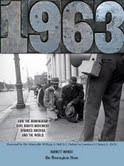
Some of those images are featured in the book, “1963: How the Birmingham Civil Rights Movement Changed America and the World,” written by Birmingham News reporter Barnett Wright. Last Wednesday, Wright served as guide for the I AM GOING ALL THE WAY tour in the newspaper’s downtown offices. He regaled attendees with informative backstories as we toured the galleries that highlight photos from the “Unseen. Unforgotten.” exhibit; we also had a chance to tour parts of the newsroom as well. Wright pointed out the newspaper’s culpability in not prominently highlighting the movement. Wright said on the day after Birmingham schoolchildren took to the streets in protest of the city’s draconian Jim Crow laws, The Birmingham News published on its front page a story about a snake that refused to eat. “They didn’t want the world to see what was going on in their own city,” said Wright.
Fifty years after that pivotal year, the newspaper is welcoming dialogue that speaks on their past role and how they want to engage the community now. The public can take this free tour tomorrow, Wed., May 29 at 10 a.m., 11 a.m., 12 p.m. and 1 p.m. Each tour lasts about an hour. Please contact Ed Fields at efields@relaitshandled.com to sign up.
Rickwood Field shines in ‘42’
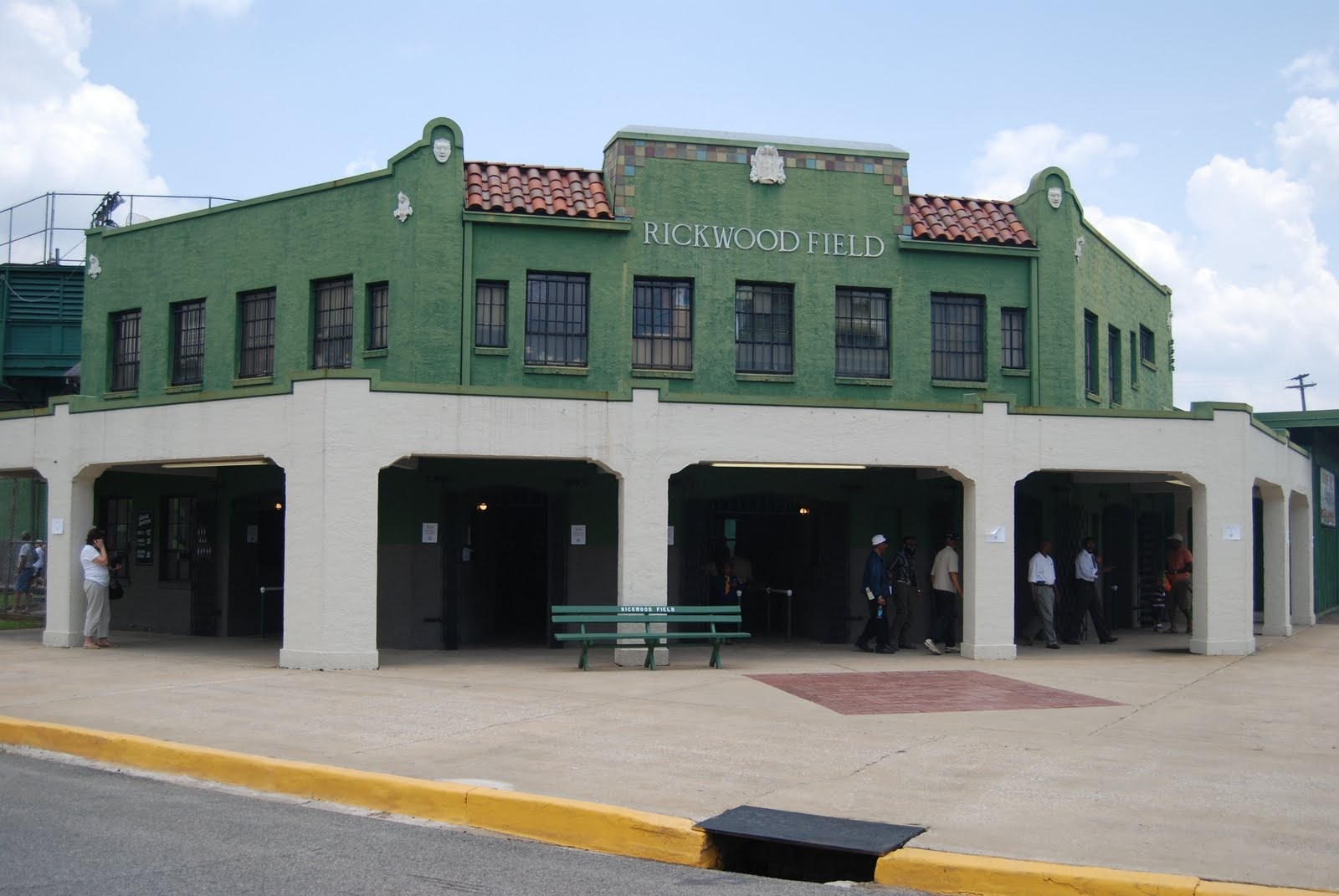
In 1910, A.H. “Rick” Woodward, son of industrialist Joseph Woodward, was majority owner of the Birmingham Barons, much to the chagrin of his father. Undeterred, Rick Woodward wanted a new stadium for his team. He visited Philadelphia to see Shibe Park, the first steel and concrete stadium. The Philadelphia Athletics played at Shibe Park, and the famed Connie Mack was part owner and manager of the A’s. Woodward persuaded Mack to visit Birmingham to help him build his field. In March, a few weeks later, Mack did just that. “…Connie Mack suggested many of the same features for Rickwood that had gone into the building of Shibe Park, including wooden louvers between the top row of the grandstand and the ballpark roof; like the ones in Philadelphia, these louvers were angled to diffuse the setting western sun in the late afternoon – though some joked that Rickwood didn’t need them because the clouds of sulfur-filled smoke from the nearby mills accomplished that,” wrote Allen Barra in his “Rickwood Field: A Century in America’s Oldest Ballpark.”
The new field generated much excitement in Birmingham; the park’s name had even been chosen through a newspaper contest. On August 17, the day before the first game played at Rickwood, The Birmingham Age-Herald wrote, “There is no doubt but that Birmingham is ‘baseball-wild.” The day of the opening, the Birmingham News stated, “When Birmingham men do a thing, they do it right.” Later descriptions of that first game said spectators overflowed the grandstand and bleachers; the crowd was estimated at well over 10,000. (One interesting tidbit: Construction workers were still on the job when fans arrived to the field.)
In 1919, one of the largest crowds at Rickwood came to witness the Birmingham Giants, an early Negro team, play a double-header with Montgomery’s Negro team. “The largest crowd of negroes that ever attended a ball game in the United States and next to the largest, irrespective of color, that ever jammed its way into Rickwood,” stated The Birmingham Age Herald. (In 1920, when the industrial league teams from ACIPCO and Stockholm Valve joined to form one professional team, they named themselves the Black Barons.) Rickwood became a favorite field of players from both the white Southern Association and the Negro League. Bill Powell, pitcher for the Black Barons in the mid-forties, once said, “I don’t know what it is, but when I was playing at Rickwood Field, I was always itching to get to the ballpark. We played all over the United States, and when we got here, you just loved coming here to play in the park. There was just something about the baseball in that park.”
Rickwood Field is now the oldest ballpark in the United States. Below are some more interesting facts on Rickwood.
•In early 1911, the New York Giants, Philadelphia Phillies and Detroit Tigers played against the Barons before returning home from spring training.
•In March 1925, an excited crowd of whites and blacks saw Babe Ruth hit a homerun over the right field ball, with bases loaded. That hit dugged the Yankees out of a two-run deficit.
•Legendary Negro League pitcher, Satchel Paige, debuted for the Black Barons at Rickwood in 1927.
•The Spanish mission-style entrance was added to the field in 1928.
•Prior to his Houston Buffaloes playing the Barons in the Dixie Series in 1931, Dizzy Dean said, “If I don’t beat them Barons, I’ll join the House of David and grow a beard and never, never shave it off. It would hide my shame.” More than 20,000 fans were on hand at Rickwood to see Dean’s Buffaloes get shut out in the first game of the double-header. The Barons lost the second game 0-3, but would go on to win the series 4-3.
•In 1938, Rick Woodward sold the field to Ed Norton, an automobile dealer, for $175,000.
•In 1947, Eddie Glennon, general manager of the Barons, allowed the Black Barons to use the same clubhouse used by the white Barons. Previously, the Black Barons had to dress in the bus on the way to the park or in the tunnels.
•In October 1948, a crowd of more than 7,000 saw Jackie Robinson and Roy Campanella and the rest of Robinson’s All-Stars play against Willie Mays and the Black Barons. The All-Stars won 3 – 0.
•No professional baseball was played at Rickwood in 1963. The Barons’ league had folded after the 1961 season; the Black Barons ceased play in 1960. (The Barons rebounded in 1964, but left the city in 1965.)
•From 1967 to 1975, the Birmingham A’s took up residence at Rickwood. In 1967, Reggie Jackson, the future Mr. October, played for the Birmingham A’s.
•The Barons returned to Rickwood in 1981. They would stay put until the team moved to Hoover in 1987.
•The baseball scenes in 1994’s “Cobb” were filmed at Rickwood.
Never visited Rickwood Field? You should make plans to see the field during this year’s Rickwood Classic on May 29, starting at 12:30 p.m. The Barons will play the Tennessee Smokies. The Barons will pay tribute to the 1948 Birmingham Black Barons by donning their uniforms. The Smokies will wear the 1935-36 Knoxville Giant uniform. (The Knoxville Giants were another Negro League team.) Ferguson “Fergie” Jenkins, Major League Baseball Hall of Famer, is the guest VIP. You can purchase tickets through the Barons’ ticket office or via http://www.barons.com. Tickets can also be purchased by calling 988-3200. Rickwood Field is located at 1137 Second Ave. West.
How Far Have We Come?
A panel discussion on “Lessons from the Past: Civil Rights Today” will take place tomorrow, March 12, at Birmingham Southern College at 6 p.m. in the Bruno Great Hall. Odessa Woolfolk, president emerita of The Birmingham Civil Rights Institute, will moderate.
Panel includes the Honorable William Bell, mayor of Birmingham; Carolyn McKinstry, eyewitness to the 16th Street Baptist Church bombing; Scott Douglas, executive director of Greater Birmingham Ministries; Isabel Rubio, founder of the Hispanic Coalition of Alabama; Howard Bayless, LGBT civil rights leader; and the Honorable Helen Shores Lee, judge of the Tenth Judicial Circuit.
Many will agree that blacks in Birmingham, and the U.S., have made great strides in 50 years, but we are far from a post-racial society as some would have us believe. Read the comments that follow any story related to race or one that features a person of color in the Birmingham News, New York Times, USA Today, etc., and you could see that this country is far from being color-struck.
In an editorial for The Minnesota Daily, Trent Kays said the last presidential election proved to him that our country was still in the throes of racism. “Equally disheartening is that we still don’t know how to deal with it. This sickness is symptomatic of a culture and society beginning to embrace 1950s ideologies again rather than moving forward with an eye on the future horizon,” wrote Kays.
I think conversations about race, like the one scheduled for tomorrow, help to foster meaningful interactions, but do these talks reach the people who are holding fast to their antiquated thoughts on race and diversity? Do they help us move a step closer to “dealing with it?”
I doubt if the person who commented on AL.com that giving blacks the right to vote has been the downfall of this country will be in attendance. I doubt if the many commenters who routinely disrespect President Obama for any little perceived offense (but swears they are not racist) will want to have this conversation.
I am all for people sharing their opinions, and so be it if they don’t line up with mine, but the racial discourse in this city, in this country, has taken an ugly turn. (Look at this awful attempt by Philadelphia magazine. The writer says he wanted to have an honest dialogue about race, but ended up with a story that’s full of negative stereotypes and the worst kind of race-baiting.) I pray that tomorrow’s discussion can do some good in getting us to talk about why are we still talking about race in 2013.
What do you think?
Legendary broadcasters to discuss Birmingham’s golden age of radio
Doug Layton started his Birmingham radio career at WSGN, Birmingham’s first rock-and-roll station. From there he moved on to WYDE where he teamed up with Tommy Charles for Birmingham’s first “two-man” radio team. However, Layton may be best remembered for what took place in 1966 at WAQY, in which he was part owner. Layton participated in a Beatles’ boycott to protest John Lennon’s claim that the group was more popular than Jesus. In addition to banning their records, Layton and Charles asked listeners to send in their Beatles records and memorabilia to be included in a bonfire on August 19. The boycott garnered national attention and other stations, particularly in the south, followed suit.
Tomorrow, Thursday, Feb. 21, Layton will participate in a panel discussion on Birmingham’s golden age of radio, along with Shelley Stewart, Bob Friedman and Courtney Haden at Vulcan Park and Museum. Greg Bass will moderate. A cash bar opens at 5:30 p.m. and the panel’s discussion will begin at 6 p.m. Tickets are $10 if purchased in advanced online or $15 at the door.
In a year that’s filled with numerous nods to Birmingham history, Cristina Almanza, director of marketing and public relations at the park, says they want to offer a different perspective. “We are trying to unveil some historical aspect people may not be familiar with.” Tomorrow’s talk is the first of three events in the park’s 2013 “Birmingham Revealed” series. Music historian Bobby Horton headlines “Music, Migration, and Industrial Birmingham on March 21; the series will close on April 18 with “Crossing Lines: Birmingham and the Southern Conference for Human Welfare.” In 1938, the conference drew Eleanor Roosevelt, Hugo Black, Mary McLeod Bethune and Virginia Foster Durr to Birmingham to help bring the New Deal to the south.
See http://www.visitvulcan.com/eventInfo/BirminghamRevealed.html for more information.
A Quiet Warrior
This year Birmingham is commemorating the 50th anniversary of the civil rights movement. Much will be said and written about Dr. Martin Luther King, Jr., Fred Shuttlesworth and other “brand-name” civil rights leaders. But let me tell you about Marian Jones Daniels, a woman whose quiet actions helped pave the way for others.
Mrs. Daniels plays piano at my church. Her stark white cropped hair is a striking contrast to her chestnut brown skin. She is a thin woman, whom I believe is now in her mid-sixties. (I’ve asked her to tell me her age, but she has politely let me know it’s none of my business.) Sister Daniels, as we call her, is always sharp in dress. On a recent Sunday, she had on a suit that reminded me of shark’s skin. She wore a chunky silver necklace and dangly earrings to match.
I like how Sister Daniels’ fingers deftly strike the piano keys. Her fingers are slender and bare, save for a gold wedding band. They glide over the ivory and black keys with what looks like little effort. Her skill is a testimony to the many years of taking piano lessons from the sternest of instructors – her mother, Bessie R. Jones, who, before her death, played piano for the church and directed the choir. (The choir in which I sing tenor is named for her.) I heard Bessie R. Jones and her husband were strict parents who didn’t let their three daughters take the easy way out of any task, be it piano lessons, school work or chores. “Our parents instilled a strong work ethic in us, and the fear of God,” said Sister Daniels.
There was a lot to fear growing up black in Birmingham in the ‘50s and ‘60s. But Sister Daniels said she wasn’t really scared of white folks and didn’t know of anyone from her close-knit community of Collegeville, a black neighborhood located just northeast of downtown, who was afraid either. Sure, the church, including the parsonage, was bombed three times, but, thankfully, no one was killed or seriously injured. Sister Daniels, the whole church and community, looked at these survivals as miracles. And these miracles were more real to them than the Israelites crossing the Red Sea, the three Hebrew boys enduring the fiery furnace or Daniel relaxing in the lion’s den. “After those bombings, we knew that the hand of God was on us, and we would be victorious,” said Sister Daniels. The church’s pastor at the time, Fred L. Shuttlesworth, felt the same way. “When the first bomb went off, it took all fear from my mind,” he said in a later interview.
With this fearless attitude in mind, Sister Daniels decided to apply to predominantly white colleges in the north and was accepted to a small liberal arts school on the eastern seaboard. She does not pretend that this school was nirvana. Even with their open admissions policy, many northern institutions of higher learning were not well equipped in handling the cultural differences and needs of the black student. In Frederick Harper’s 1969 essay, “Being Black in a Predominantly White University,” he captured the despair a number of black college students may have been feeling about matriculating at all-white schools.
If you can listen with an accepting ear and try to get into my frame of reference, I will attempt to articulate what it means to be black in a white university.
Being Black means to walk across campus on your first day of class and not see one black student.
Being Black means to have all white teachers and be surrounded in class by all white or nearly all white students.
Being Black means to open my textbooks and see pictures of white folks and to read white-washed theory, philosophy and history which are not relevant to me.
Being Black means to go to a white counselor whom I don’t trust, and who doesn’t know how to handle my presence or problem.
Being Black is trying to get administrators to understand my needs and do something about them, or trying to convince a campus policeman that he should not arrest me out of prejudice.
Being Black is tolerating “Nigra” or “Negro” and favoring neither.
Being Black is seeing a soul sister or brother slaving overtime on a dirty menial job and being underpaid.
Being Black is to go into a class disadvantaged and find that I have a teacher who believes it is impossible for a black student to make an “A” or “B” grade.
Being Black is not having a penny in my pocket and seeing white students visit Europe and Mexico, driving fancy sports cars, and at the same time knowing that their parents and ancestors got rich off the sweat and pain of my parents and ancestors.
Being Black is to be a resource person for curious white folks who after being answered, are not willing to accept my expertise…
Being Black means to be in an ocean of white stimuli, to be angry consciously or unconsciously, to continuously struggle with oneself to deny hostile feelings, angry feelings. I might add that there is no difference between a black rioter and that of a black Ph.D. but rather a difference in the way this feeling comes out.
Finally, being black means to be lonely, hyperalienated, depressed, displayed, ignored, and harassed. Just the fact of being black is to be on the brink of revolt.
But unlike Harper, Sister Daniels stated her upbringing would not allow her to lament over what she did not have. She was raised to be thankful and to make the most of every opportunity. “From the time we were small, we were told we had to be twice as good, twice as smart. We were not sad or mad about it. It was a fact and we just went about doing what we had to do to succeed.” Sister Daniels does not equate her collegiate experience to one of near revolt, but rather as an awakening. For the first time in her life, she shared a classroom with white students and discovered that she was just as academically sharp, or sharper than they were.
After graduating, Sister Daniels moved back to Birmingham. Similar to the black World War II GIs who were determined not be hindered by the rules of Jim Crow, Sister Daniels wanted to lead a life outside the box mainstream Birmingham may have wanted to stick her in. She didn’t want to teach like her oldest sister or become a nurse like the middle one. Sister Daniels wanted to enter the corporate world, which was a new frontier for blacks at the time. She had read about a clerical position at a utilities company headquartered downtown.
In 1940, U.S. census data showed more than 58 percent of black women worked as domestics and less than 2 percent were hired for clerical positions. A federal Women’s Bureau study showed that almost half the northern and southern employers surveyed had an unwritten rule against hiring blacks to work in their offices. But by the late 1960s, times were changing.
Sister Daniels applied and on the day of her interview she dressed in her best suit, replete with a double string of pearls and sensible pumps. She interviewed with the supervisor, the supervisor’s boss and that boss’s boss. She got the job. Sister Daniels became the first black to be hired for a non-custodial position at that company. Her hiring could be attributed to a change in attitude and belief systems among white decision makers at that time. Economist Mary C. King named this phenomenon as “occupational tipping.” Others point to the civil rights movement and subsequent federal anti-discrimination laws as the catalysts for change. And, still, others say the shift was caused by both. Nevertheless, by 1966, 13 percent of black women worked in clerical or sales positions, according to the U.S. Department of Labor.
Sister Daniels recalled her first day at work. “I remember the elevator man looking me up and down when I got on the elevator. I don’t think he had ever seen a black person come to work dressed in a suit. He asked me what was I doing there and I told him I was new and would be working in the accounting department. He told me that all the blacks ate lunch on the top floor at noon and he would see me there.”
When Sister Daniels reached the top floor at noon, she couldn’t believe her eyes. “All the black workers met in this dark little musty-smelling room that was filled with broken furniture. I found a seat in this raggedy chair and ate my sandwich. I was miserable and decided right then I will never eat in that place again.” The next morning she encountered the elevator man again. When he told her he would see her at lunchtime, she told him that she would not be joining them as she would be eating her lunch in the cafeteria from now on. “He was shocked and told me that the blacks weren’t allowed to eat in there. I told him that this black person would be eating there because there was no way I would be eating in that junk pile anymore,” she said. “My parents didn’t send me to college to eat like that,” Sister Daniels added.
All morning, Sister Daniels worked with butterflies in her stomach. When the designated time came, she retrieved her lunch and made her way to the cafeteria. “I found a seat at an empty table. I could feel people staring at me, but I didn’t look at anyone. I thought at any moment someone was going to tap me on my shoulder and escort me out the door,” she said. But no one ever did. Not that day or the next day or the day after that. But at the end of the week, Sister Daniels’ supervisor told her she wanted to speak with her. “If she was going to tell me that I could not eat in the cafeteria, I was prepared to leave that day because I wasn’t going to eat anywhere else.” But that was not what the supervisor wanted to say. “She actually told me she was proud that I decided to eat in the cafeteria. She said there was no rule barring blacks from the cafeteria and she always wondered why the other black employees did not eat there. This taught me that sometimes the worst monsters are the ones we create.” Eventually, other black workers joined her in the cafeteria.
Before retiring from the utilities company, Sister Daniels became the executive secretary of one of the top officers there, the first black to ever reach such a position.
Sister Daniels plays the piano at my church, and blazes trails, with what looks like little effort.
Sources:
Schudel, Matt, “Fred Shuttlesworth, courageous civil rights fighter, dies at 89,” Washington Post on the Web October 5, 2011. December 26, 2011 www.washingtonpost.com/local/obituaries
Harper, Frederick D., “Black Student Revolt on the White Campus,” Journal of College Student Personnel (Sept. 1969): 29.
Sundstrom, William A, “From Servants to Secretaries: The Occupations of African-American Women, 1940-1980,”working paper (May 2000).
King, Mary C., “Black Women’s Breakthrough into Clerical Work: An Occupational Tipping Model,” Journal of Economic Issues 27.4 (Dec. 1993), 1097-1125:
United States. Department of Labor. Wage and Labor Standards Administration. “Negro Women…in the Population and in the Labor Force,” (Dec. 1967).
Robert Chambliss and the Tale of Two Nieces
The Archives department of the Birmingham Public Library is making Robert Edward Chambliss’s jailhouse correspondence available to the public today, the 35th anniversary of the start of Chambliss’s trial. The papers were given to the library by the FBI. In 1977 Chambliss was convicted to a life sentence for the murder of Carol Denise McNair, 11. McNair, along with Addie Mae Collins, Carole Robertson and Cynthia Wesley, all 14, was killed in the 1963 bombing of the 16th Street Baptist Church.
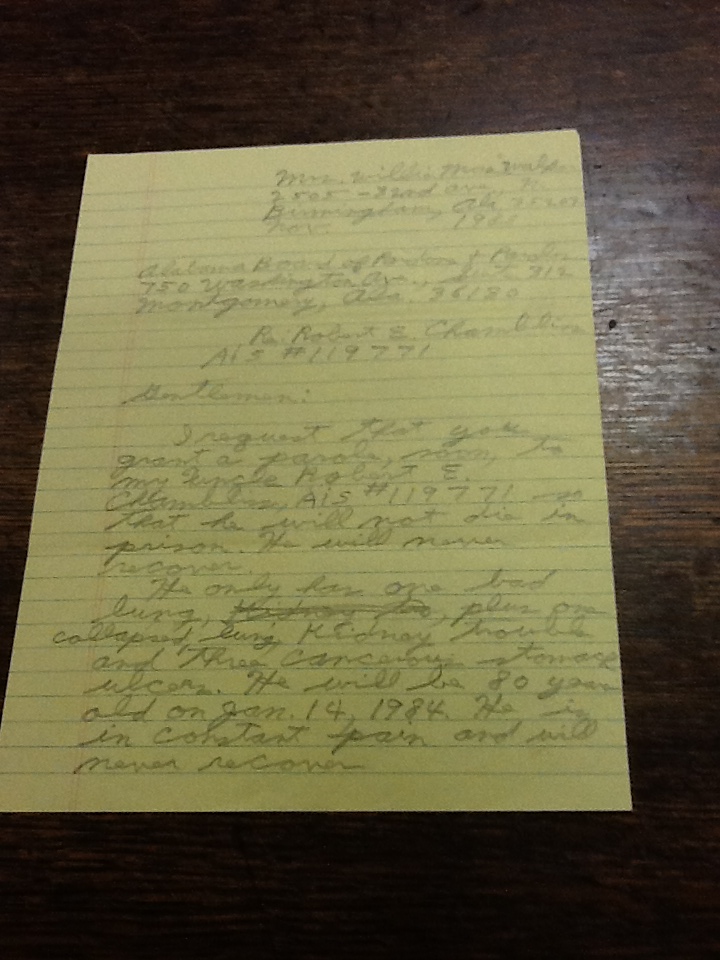
Yesterday, I had an opportunity to review the letters, which were written on yellow legal paper and in cursive. Chambliss wasn’t concerned with modern grammatical conventions as he disregarded many commas and periods and capitalized words at random. Given the age of the letters, I was surprised to find that the ink had not faded.
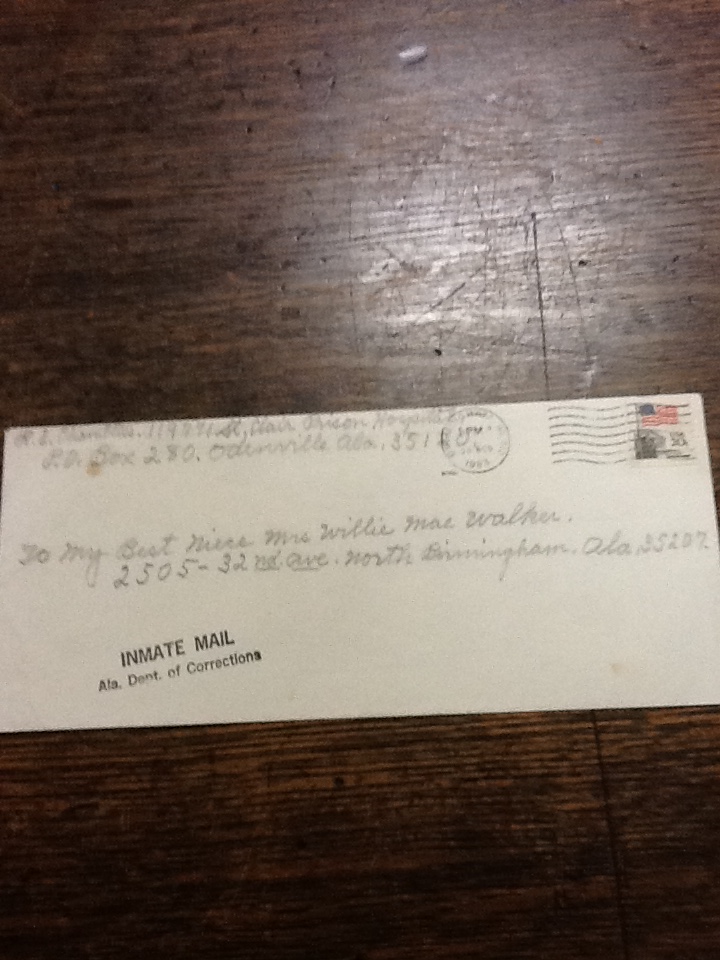
Many of the letters are written to his niece Willie Mae Walker. Chambliss addresses the envelopes with “To My Best Niece Mrs. Willie Mae Walker.” Within the letters, he would make numerous requests of Walker from sending him money for cigarettes to contacting “Good White” lawyers who could help get him released from prison either for good behavior or medical reasons.
In one letter, Chambliss asked Walker to contact the local newspapers and place the following ad:
Who Will Help an 80 year old innocent convict to get out of Prison.
His Doctors Say He Will Never Be Well Again. He is Being Held a Political Prisoner
Who needs to Be Free Before He Dies. Please Write R. E. Chambliss, 119771
St. Clair Prison Hospital P.O. Box 280 Odenville Alabama 35120
Sure enough, Walker sent a typed letter to the Birmingham News’s advertising director Harris Emmerson to find out ad rates for a two-week run.
Chambliss also asked Walker to track down another niece, Elizabeth Cobbs or Libby Ann as Chambliss called her. Many observers of Chambliss’s trial say it was Cobbs’s testimony that sealed his conviction. Cobbs, a Methodist minister, was the prosecution’s star witness. In Spike Lee’s 1997 seminal documentary, Four Little Girls, Howell Raines, the former executive director of the New York Times and Birmingham native, said “The old man [Chambliss] looked over his shoulder and sees this woman walking in and he turns around. His attorneys lean over to him and ask him ‘Who is that?’ And it’s clear they’re totally unprepared for this witness.”
Cobbs testified that while watching news reports of the bombing, her uncle said, “It wasn’t meant to hurt anybody. It didn’t go off when it was supposed to.”
Chambliss wanted Walker to find Cobbs so she could “repent” of her testimony. Chambliss blamed Cobbs for his conviction. In one letter dated December 18, 1983, Chambliss wrote, “…She Swore Lies on Her Uncle and got Him Charged with 4 Murders and got Him a Life Sentence.” He thought the Methodist church may have known of Cobbs’s whereabouts; he told his niece to contact them. Chambliss never mentioned he knew that Cobbs underwent a sex change in 1981 and changed his name to Petric Smith. In 1994, Smith wrote Long Time Coming, in which he recollects about growing up with violent segregationists and how he felt during the trial. Chambliss died a prisoner on October 29, 1985. Smith died in Birmingham in 1998 from lung cancer. He was 57.
Historians and journalists have given no treatment to Walker. I want to know more about her, this best niece. Did she believe in her uncle’s innocence? Did she feel a sense of relief after his death? Is she still alive? As with any important find, we are left to discover answers through additional digging. If you were able to ask Walker one question, what would it be?
The Archives department is located in the Linn-Henley Research Building and is open from 9 a.m. to 6 p.m., Monday – Friday.
Racing in the Junction
There’s an old place where people go/ To dance the night away/ They all drive or walk for miles/ To get jive that southern style/ It’s an old jive that makes you want / To dance till break of day…Come on down, forget your care/ Come on down, you’ll find me there/ So long town, I’m heading forTuxedo Junction now (Lyrics from Tuxedo Junction)
For many Birmingham-area blacks in the 1920s – 1940s, Tuxedo Junction, located in the working- class enclave of Ensley, was the place to be. A thriving commercial district for blacks, Tuxedo Junction was located at the intersection of 20th Street and Ensley Avenue, just where the Birmingham, Railway, Light and Power Company trolley lines split. Birmingham native Erskine Hawkins, composer and trumpeter, wanted to capture the district’s energy with his song, “Tuxedo Junction.” The tune later gained in popularity after being recorded by Glenn Miller. Tuxedo Junction didn’t just consist of jive joints and nightclubs; well-to-do businesses took up residence as well. In his study, Downtown Ensley & Tuxedo Junction, David B. Schneider wrote that the Belcher-Nixon Building, which was located in the heart of Tuxedo Junction, contained many black-owned businesses, including the dental office of civil rights leader Dr. John W. Dixon.
The area has suffered serious decline since its heyday. It is now dotted with neglected commercial buildings, but many see hope in the revival. In a Birmingham News article about their book, “Ensley and Tuxedo Junction,” authors David Fleming and Mary Allison Haynie said they wanted the book to serve as a beacon on the importance of Ensley and Tuxedo Junction. The book highlights more than 200 photographs that were mostly culled from area residents. Fleming is a former executive director of Main Street Birmingham, a nonprofit organization that is working to revitalize Ensley, along with other Birmingham-area business districts.
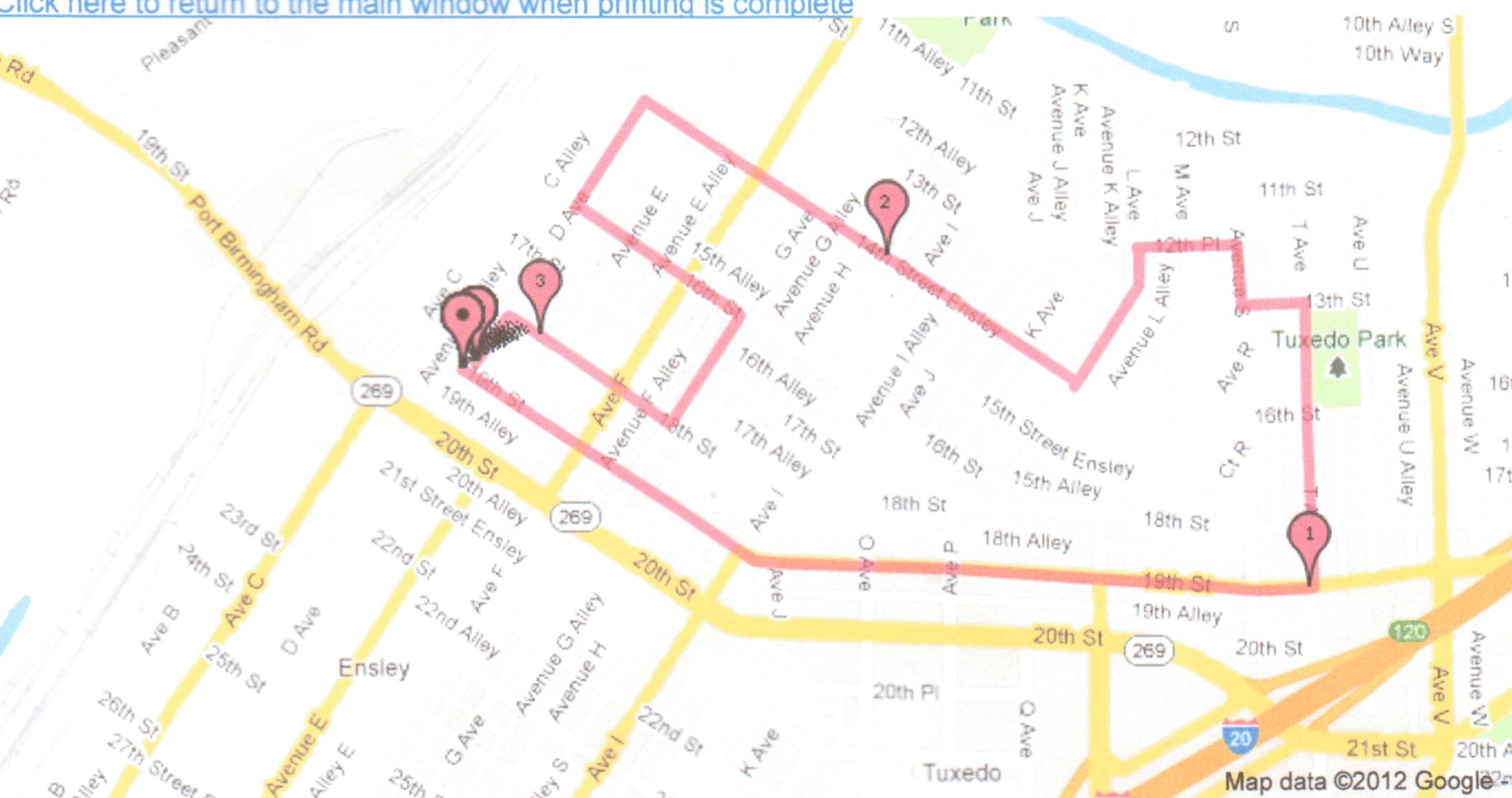
Jerri Haslem also believes Ensley, and Tuxedo Junction, can see better days, and not just in the terms of business renewal but also in improved health of its residents. Haslem, local fitness expert, is organizing the 5K at the Junction, a 3.1 mile race that will start tomorrow, November 10, at the Bethesda Life Center, 321 19th Street Ensley, at 8 a.m., not far from Tuxedo Junction. A one-mile fun walk is also planned. Haslem wanted to bring awareness to the community on issues of health disparities, chronic diseases and obesity. Haslem selected Ensley as the race’s setting because, “it is indeed an underserved community when it comes to health disparities. We hear so many negative things about the Ensley community. Not every community is 100% good or bad,” she said.
Three hundred runners have registered so far. There’s still time to sign up if you want to participate in this historic race. Cost: $20 before race day; $25 day of race. You can go here to register or you can go to The Bethesda Life Center today, now until 6 p.m. to sign up.