
We got the news at the end of the seventh inning. There’s some sad news to report tonight, the announcer said. Willie Mays has died. There were collective groans from those of us in the Rickwood Field stands. The players on the field removed their caps and everyone turned their attention to the Jumbotron that displayed a montage of photos highlighting Mays’ megawatt smile and videos showing his unbelievable athletic talent. At the end of the homage, we stood and applauded for several minutes.
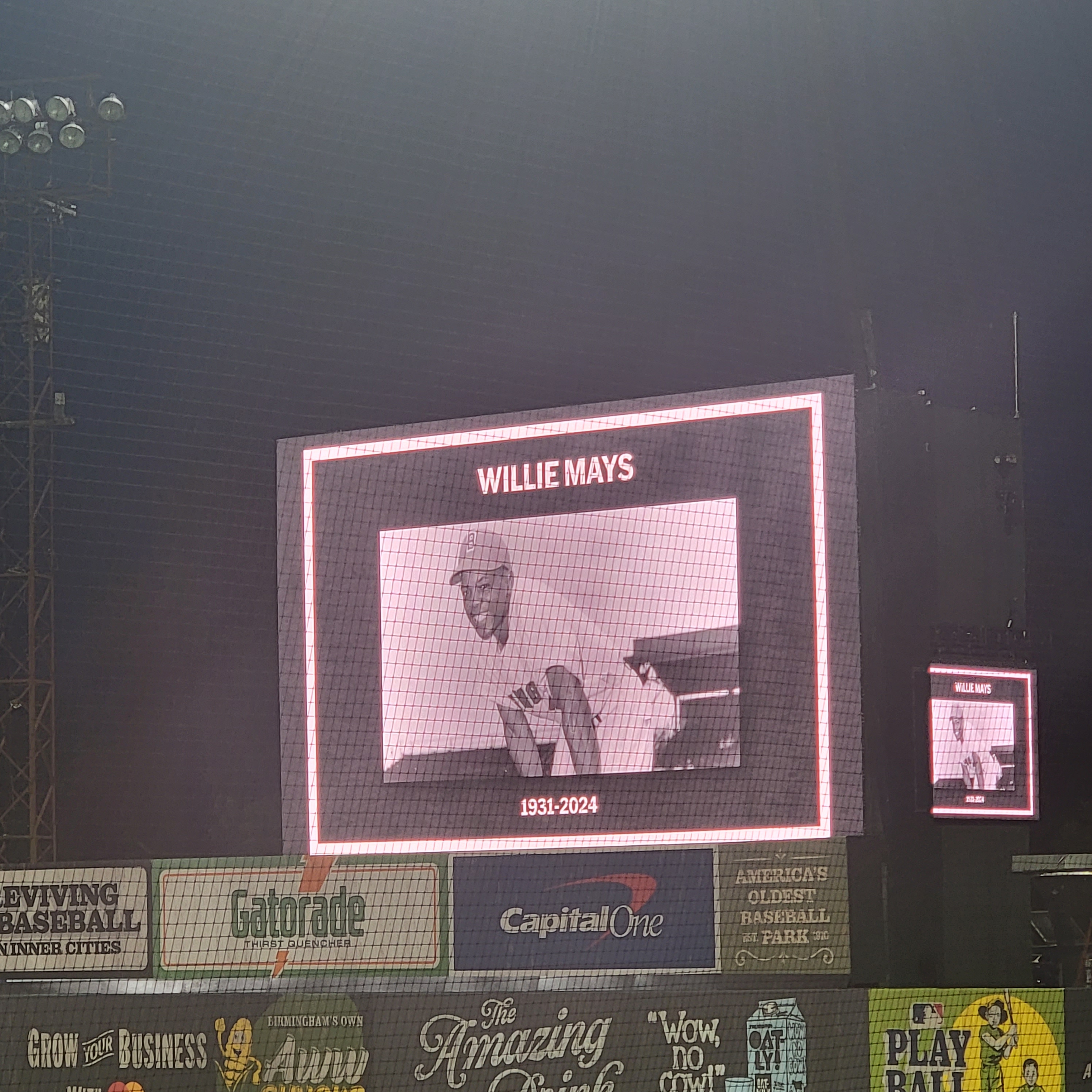
Photo caption: A photo of Willie Mays appears on Rickwood Fields’ Jumbotron.
The standing ovation was fitting as we were there to honor Negro leaguers, like Mays, who became household names as well as those who didn’t reach the limelight. Tonight [06/18/2024], we were there to watch the Birmingham Barons playing as the Black Barons and the Montgomery Biscuits playing as the Gray Sox. To be sitting in the stands where Mays got his start cast a certain reverence to the evening.
Willie Howard Mays, Jr. was born May 6, 1931 in Westfield, Alabama. His father, Cat Mays, played industrial league baseball (and I’d heard he was even better than Willie), His mother, Annie Satterwhite, was an exceptional athlete as well. Cat placed a bat and glove in Willie’s hands at an early age. He played baseball, football and basketball at Fairfield Industrial High School. In 1948, Mays began playing for the Black Barons and helped them get to the that year’s Negro World Series against the Homestead Grays. (The Barons lost 4 – 1.)
After graduating high school, Mays signed with the New York Giants in 1950. After playing minor league ball, Mays was called up in 1951. You can read more about his professional career here:https://baseballhall.org/hall-of-famers/mays-willie
At the end of tonight’s game, the mood was somber but something else was in the air – gratitude. We are grateful that Willie Mays will forever be Birmingham’s own.
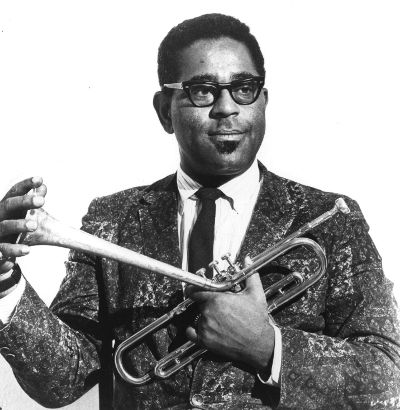 On this day in 1993, Dizzy Gillespie died in Englewood, NJ. During the 1940s and ‘50s, Gillespie regularly brought his style of jazz to Birmingham, visiting such venues as the Municipal Auditorium (now the Boutwell Memorial Auditorium) and the Masonic Temple.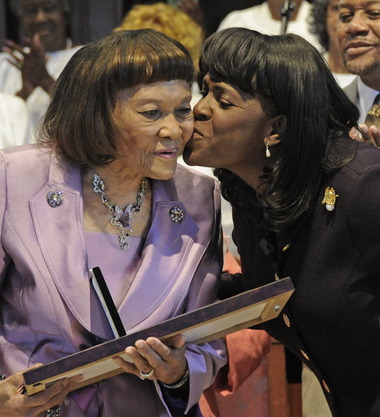
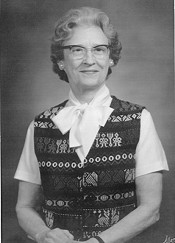 Branscomb was a sociology professor at Birmingham-Southern College from 1938 to 1947. During a feature on Branscomb in an issue of the school’s alumni magazine, one student remembered her as “caring and she wasn’t afraid to talk to her students, especially females, about issues that weren’t talked about very much then…like family planning.”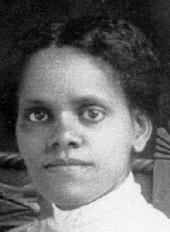
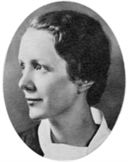 Helen Sellers Davis was the first licensed female architect in Alabama. Davis trained at Alabama Polytechnic Institute (Auburn University). She married one of her instructors, Charles Davis, and after her 1935 graduation, the couple moved to Birmingham. Helen received her state registration in 1936.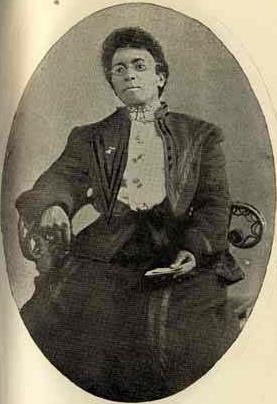

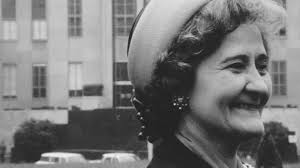 Three years earlier, Miglionico was elected to the newly-formed city council, becoming the first woman to sit on the council. In addition to fighting for women’s rights, Miglionico was also a vocal critic of the treatment of blacks in the city. Because of this she became a target of white supremacists who placed a bomb under her porch in 1965. (Her 80-year old father was able to defuse it.) Crosses were burned in her yard as late as 1974.
 The Birmingham Buff