
Over the next 30 days, The Birmingham Buff will feature 30 remarkable women who have made their mark on Birmingham’s history.
Woman You Should Know #11
Beatrice Muse Price was born in Bessemer and moved to Greensboro in Hale County when she was three. Growing up, Price, a granddaughter of slaves, knew she wanted something different than what others may have wanted for her. The fear of being stuck in the county’s dirt served as motivation. “They told me if my grades weren’t good enough, I’d be sent back to the kitchens or the fields,” she said in this interview.
Good grades paved the way for her to study nursing in Atlanta, and she eventually served in the Army Nurses Corps from 1944 to 1948. At one time, she was assigned to a group of Tuskegee Airmen as they trained at Lockbourne Army Airfield, near Columbus, Ohio.
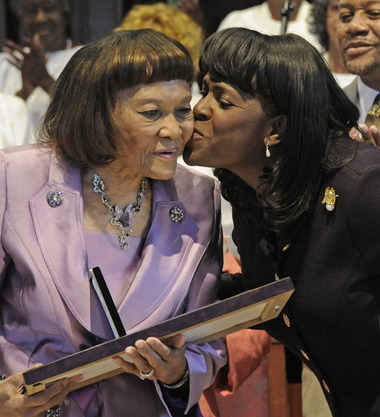
Beatrice Price (l) receives a kiss from U. S. Rep. Sewell after she was awarded the Congressional Gold Medal.
Before Price went to Lockbourne, she worked at an army hospital with only eight other black nurses. In an interview, she remembered the pressure she and the others were under to prove they were just as qualified. “It was a struggle,” she said.
After her time in the Army, Price moved to Birmingham and worked as a nurse for 34 years at the Veterans Administration hospital.
In 2012, Price was awarded a Congressional Gold Medal for her service during World War II.
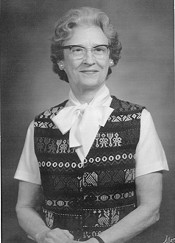 Branscomb was a sociology professor at Birmingham-Southern College from 1938 to 1947. During a feature on Branscomb in an issue of the school’s alumni magazine, one student remembered her as “caring and she wasn’t afraid to talk to her students, especially females, about issues that weren’t talked about very much then…like family planning.”
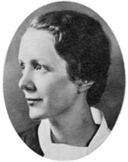 Helen Sellers Davis was the first licensed female architect in Alabama. Davis trained at Alabama Polytechnic Institute (Auburn University). She married one of her instructors, Charles Davis, and after her 1935 graduation, the couple moved to Birmingham. Helen received her state registration in 1936.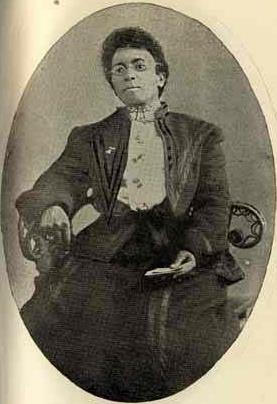
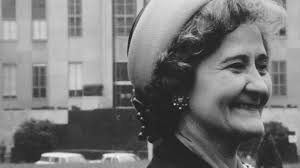 Three years earlier, Miglionico was elected to the newly-formed city council, becoming the first woman to sit on the council. In addition to fighting for women’s rights, Miglionico was also a vocal critic of the treatment of blacks in the city. Because of this she became a target of white supremacists who placed a bomb under her porch in 1965. (Her 80-year old father was able to defuse it.) Crosses were burned in her yard as late as 1974.
 Estell once called her father a pioneer in promoting civil rights in the city, but she was a pioneer in her right, having been the first black woman elected to the city council in 1975.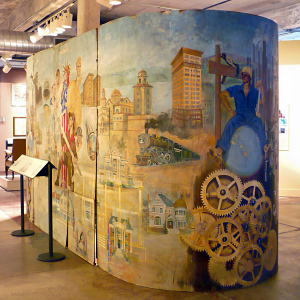
 The Birmingham Buff