The Long Hill of the Dyed Rock

30 Things I Didn’t Know about Birmingham

I am sharing interesting tidbits I’ve recently learned about Birmingham and some of her people. These items may be new to you as well or just a reminder. 

Number FIVE

Long before Birmingham was established in 1871, Native Americans around these parts referred to Red Mountain by the aptly descriptive name of “The Long Hill of the Dyed Rock.”  They and white settlers used the reddish rocks (iron ore) to dye fabrics. According to “True Tales of Birmingham,” in the 1800s, “a few bars of iron were priceless and several area blacksmiths tried, without success, to forge iron from the mountain’s rich supply of reddish ore.”

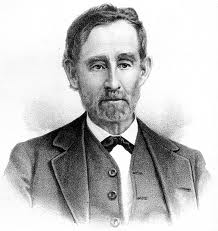
Baylis Earle Grace (1808-1893)

Baylis Earle Grace (1808-1893)

Enter Baylis Earle Grace, who, as a 12 year-old, came to Jefferson County in 1820 with his parents. As a grown man, he purchased a farm in the Oxmoor Valley. In the 1850s, Grace gathered a wagon load of iron ore from his land and drove it to a puddling furnace in Bibb County where the ore was turned into iron bars. Legend has it that Grace always kept one of the bars on his desk as a reminder of his feat.

From Slave to Inventor

30 Things I Didn’t Know about Birmingham

I am sharing interesting tidbits I’ve recently learned about Birmingham and some of her people. These items may be new to you as well or just a reminder. Please join me each day for a new fact.

Number FOUR

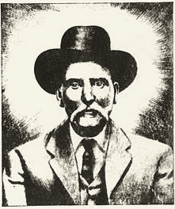
Recently I’ve learned about a former slave who was perhaps this area’s first black millionaire. Andrew Jackson Beard, born in 1849, grew up a slave in Jefferson County. After gaining emancipation at 15, he became a farmer. However, farming did not appeal to Beard. After a while, he began working for the Alabama and Chattanooga railroad. Several reports state he lost a leg and a couple fingers due to the dangerous work of coupling cars (where a worker would stand between the cars and guide the link into a coupler pocket as the cars came together).  Whether these reports are true or not, it’s no secret that this work was risky. According to the African-American Registry, a website that promotes black history education, “Few railroad men kept all their fingers, many lost arms and hands. And, many were caught between cars and crushed to death during the hazardous split-second operation.”

Beard invented what would become known as the “Jenny” coupler. His invention took away the need for a man to stand between the uncoupled cars. A patent was issued for the device on November 23, 1897.  Beard is also credited with inventing a rotary engine and a plow. He also dabbled in real estate. The book “True Tales of Birmingham” states his inventions made him a rich man, and he is thought to be Jefferson County’s first black millionaire.

Unfortunately, Beard became penniless after suffering several losses. He died in 1921 and is buried in Woodlawn Cemetery in an unmarked grave. 

Andrew Jackson Beard

Andrew Jackson Beard

Lost Beauty

30 Things I Didn’t Know about Birmingham

 I am sharing interesting tidbits about Birmingham and some of her people that I’ve recently learned. These items may be new to you as well or just a reminder. 

Number THREE

Birmingham is filled with older, stately homes that seemed to have gotten finer with time. And many neighborhoods, from Avondale to Norwood, are experiencing a renaissance of sorts, where long-neglected structures with good bones are being handsomely restored. But only recently have I learned of a masterpiece of a house, a real beauty, that was eventually demolished to make way for the Elton B. Stephens Expressway in the early 1960s. 

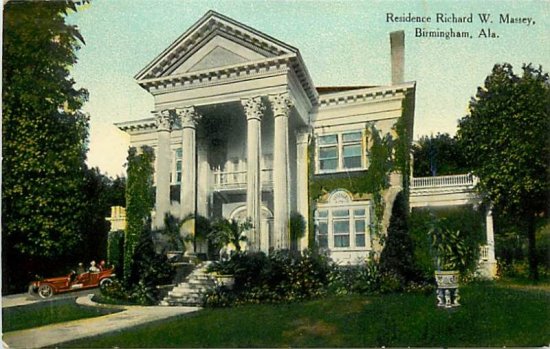
Located at 1401 Beech Street (now 21st Way South),  architect Joseph C.Turner designed and built the house to serve as a showpiece, as a testament to his skills. It has been described as beaux-arts style and Greek revival; perhaps, Turner designed the house to be a bit of both. According to bhamwiki.com, the 20-room mansion featured “a circular entrance hall with a marble fountain at the center. A circular stair gave access to the second-floor bedrooms while the top of the rotunda had a stained-glass dome which was illuminated at night. Each room, including the bedrooms, had a fireplace with a unique, hand-carved mantelpiece and a crystal chandelier.”

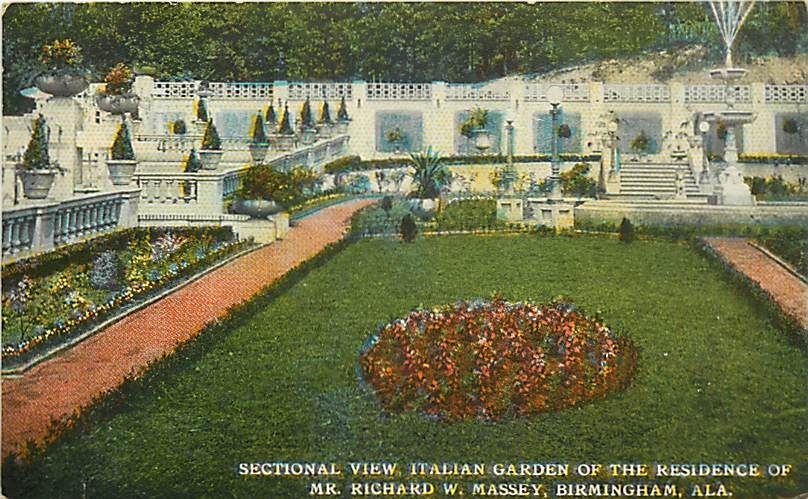
Unfortunately, Turner and his family never got the chance to move in as his wife died from pneumonia after refusing treatment because of her faith in Christian Science. The architect sold the house to a prominent businessman in town, Richard Massey, founder and owner of Massey Business College.  Massey and his wife called the house Turner and hired an Italian gardener to create the city’s first Italian garden. The place was reknown throughout the city and the South.  The Masseys even hosted President Taft during his visit to the city 105 years ago today.

Click here for more information. 

The Massey Residence

The Massey Residence

The Massey Residence's Italian Garden

The Massey Residence’s Italian Garden

Margaret Walker – Native Daughter?

30 Things I Didn’t Know about Birmingham

Number TWO

 I am sharing interesting tidbits about Birmingham and some of her people that I’ve recently learned. These items may be new to you as well or just a reminder. 

You have probably read “Jubilee,” the beautifully written historical novel by Margaret Walker, but did you know that Walker was born in Birmingham in 1915? In her book, “Conversations with Margaret Walker,” she wrote that her father pastored a church in Enon Ridge (near Fairfield) and all four children were born here. Her family remained in Birmingham until they moved to New Orleans in 1925.

When she talked about what it took to write “Jubilee,” which is set during the Civil War, Walker recalled soaking up her grandmother’s stories about her mother’s time spent in slavery. It was in Birmingham where Walker first heard her grandmother’s stories that fueled her imagination and helped her create an American classic.

Click the following for more information on Margaret Walker: http://www.encyclopediaofalabama.org/face/Article.jsp?id=h-2430.

Vulcan and the Teacher

30 Things I Didn’t Know about Birmingham

I am sharing interesting tidbits about Birmingham and some of her people that I’ve recently learned. These items may be new to you as well or just a reminder. 

Number ONE

Vulcan and the Teacher

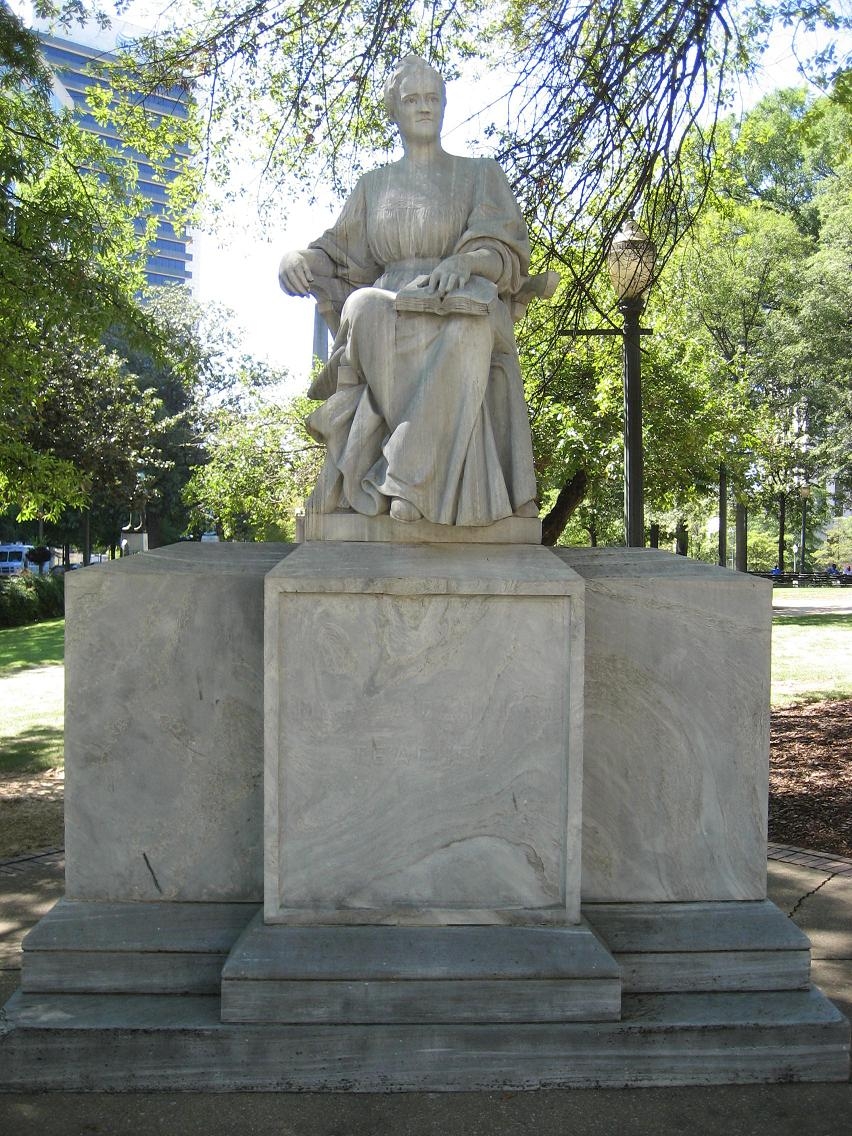
Walk through Linn Park headed toward Birmingham’s world-class Linn-Henley Research Library and you’ll pass a statue of a handsome, studious woman. The statue depicts Mary A. Cahalan resting a heavy book on her lap; it’s a pose worthy of her position as teacher and then later principal of Powell School. The statue was dedicated on May 1, 1908, two years after Cahalan’s death, and restored in 2006.

Did you know that Giuseppe Moretti sculpted the piece? His name should sound familiar as Moretti (1857 – 1935) also designed Vulcan, the city’s much-loved iron man.

Statue of Mary A. Cahalan

Statue of Mary A. Cahalan

Giuseppe Moretti

Giuseppe Moretti

Jeffreen’s Swan Song

Jeffreen M. Hayes, Ph.D., said Birmingham Museum of Art’s newest exhibition, “Etched in Collective History,” is her public thank-you to the Magic City. The former Andrew W. Mellon Curatorial Fellow in African American Art at the museum shared her thoughts during the opening lecture on Friday evening. The exhibit fills all three Jemison Galleries and features 33 artists and 56 pieces of art. The exhibit includes photography, paintings, installation, collage, paintings, prints, drawings, and sculptures.

Early in her talk, Hayes read from an essay she’d written for a local publication. In the essay Hayes writes about the pull Birmingham had on her life, one that even she was unaware of. “During my tenure, several new and old friends asked me, ‘What made you choose Birmingham?’ For a while, I could not articulate exactly why, except for the job opportunity. After spending the past year and half here, however, I can now express why I chose Birmingham…I realized that as much as I chose Birmingham, Birmingham chose me.”

Hayes relayed a childhood experience where she was picked to participate in a Black History Bowl her junior year in high school. During her preparation, Hayes checked out several books from her hometown library. One of those books was “Eyes on the Prize.” “I had never seen images like that before: black people demonstrating their dignity and working together, all for the right to be seen and respected as human beings, and withstanding the brutal force against them having what was rightfully theirs. Birmingham’s struggles were front and center – and disturbing – but stayed in my consciousness all of these years.”

Those images, and a connection to the Birmingham struggle, guided her through the exhibit’s selections. Hayes said her output was a labor of love. “I’ve poured my soul into it. It’s really hard to think about 1963 or the civil rights movement and look at the works and not connect to it personally.” Hayes said it’s her goal that the exhibit’s viewer also makes a connection.

She elaborated on a handful of pieces. Hayes considers two of those as the exhibit’s anchors. One, “There were Saturday afternoons,” is an installation by Shinique Smith that was just completed this week. The work features four doll houses that represent each girl who died in the 16th Street Baptist Church bombing. Smith weaved in locally donated toys, books, shoes and clothes, all things the girls would have continued to enjoy had they lived. The other anchor is an installation by Atlanta-based artist Radcliffe Bailey. The piece “takes you to church” with Bailey’s interpretation of 16th Street Baptist Church’s sanctuary. The work features portraits of the four girls and viewers can hear strains of John Coltrane’s “Alabama” from a vintage radio.

In addition to Smith and Bailey, the exhibit includes artwork from Zoe Charlton, Thornton Dial, Art Bacon, Chris McNair, Jefferson Pinder and others. Hayes admitted some of the pieces may be shocking to some, but that was not the goal. “The pieces are provocative to get people talking. I want us to have that [hard] conversation about diversity, about race.”

Hayes, whose fellowship recently ended, has to Chicago to work with artist Theaster Gates. “Etched in Collective History” opens Sunday at noon at the Birmingham Museum of Art, 2000 Rev. Abraham Woods Jr. Blvd. It closes November 17. Admission is free.

image

James L. Baggett, Birmingham’s History Keeper

My grandmother – and Bob Dylan – used to say “I’ve forgotten more than you’ll ever know.”  I’m not sure if that’s true of Dylan, but I believed my grandmother, a life-long student who died days shy of her 92nd birthday.

If James L. Baggett, head of the Department of Archives and Manuscripts at the Birmingham Public Library, told me that, I’d believe him, too.  How could I not? He has worked almost 20 years among more than 30,500,000 documents, photographs and drawings, and other artifacts.  And if you’d ever been blessed to attend one of his walking tours, then you know he could rattle off a timeline on Birmingham history in his sleep.

I recently spoke with Baggett in his basement office at the Central Library.  You can join the conversation below.

Are you from Birmingham?

James L. Baggett: Yes, I was born here.

Where did you attend college?

UAB and Alabama.  I received my bachelor’s and master’s in history at UAB, and at Alabama I did a Master of Library Science.

How did you become interested in what you are doing now, in archival work?

Sort of by accident.  I was a history major at UAB and when I entered the master’s program, I thought I was going to do a straight history master’s, but they offered a public history program, which is about archives, museum management, historic site management. So I did the public history master’s and interned down here with Marvin Whiting who was my predecessor.  And then I entered the Ph.D. program at Ole Miss.  I thought I wanted to be a history professor, and I found I didn’t like it. I didn’t enjoy teaching. I had really enjoyed archives so I came back. I was lucky enough to get a job here and I did the library master’s.  I never regretted it. 

Did you like Oxford at all?

I liked Oxford a lot. I really liked living there. I liked Ole Miss and I’m glad I went. I finished the classwork; I learned a lot. I just realized the academic world just wasn’t where I wanted to be.

Does it get pretty lonely as an archivist?

Not really. Well, it depends. It doesn’t here. You know there are a lot of archivists who are known as lone arrangers, and they are “one-person shops.”  That might get kind of lonely. Down here we have a full-time staff of five. We always have interns, volunteers. So at a given time we’ll have anywhere from six to 10 people working down here. And we serve 150-200 researchers a month so it’s a pretty heavily used collection.

A number of authors have given your department “a shout out” because of your assistance.

There are now more than 300 books that have been published out of this collection.  That includes five winners of the Pulitzer Prize. And the last time I counted, there have been over 50 documentaries and film productions researched here, and that includes one winner of the Academy Award, Emmy Award winners, and Peabody winners.  There have been at least 30 museum exhibitions researched here.  But then you know, we also serve local college students and people researching a house or a building so it’s a broadly used collection.

So, what does the collection consist of, what do you house down here?

We have a variety of things. We focus on the Birmingham area, but within that, it’s a pretty broad collection.  We’re the archives for the city so we house city records of historic value.  We have papers of the mayors from George Ward to Richard Arrington. We serve as the archives for a lot of local organizations like OMB and the Chamber of Commerce, the YMCA, YWCA, the League of Women Voters, a lot of local clubs. We have company records, family papers. We have the largest collection in existence on the civil rights movement in Birmingham. We have the largest collection on women’s history in Birmingham. We have something in the neighborhood of 30,000,000 documents and half a million photographs. 

Of course, you know, when we talk about archives, we’re talking about letters, diaries, notebooks, maps, blueprints, office files, church registers – pretty much anything you can think of, you can use to record information.

What’s the most unusual thing you’ve come across in the collection?

Probably fragments from the second Bethel Baptist Church bomb. 

That’s my church, actually.

The second bomb, you know the one Will Hall [one of the men who voluntarily guarded the church] picked up and carried out into the streets, we found its fragments in the Birmingham police files. We found metal fragments of the bucket the bomb was placed inside of and pieces of shrapnel from that bomb. Some of those are now on display at City Hall.

How do you keep everything catalogued?

We inventory things at a file level. We can’t inventory all the documents. There’s tens of millions, there’s just no way to do that. So we create finding aids. It’s a guide to a collection that will list each file and tell you what’s there. We try to give a researcher a good general idea of what’s in a collection so they can know which files they might need to look into and which files they could pass over.

What’s your favorite thing about your work?

I guess there are several. Working with researchers is one. People come in with really interesting ideas, really interesting projects, and we find out how we can use our collections in ways that have never been thought of. It’s always fun to start with the research in the beginning, and when it’s done, they produce a book or an article or a Ph.D. dissertation.  And finding new collections is fun.

If you could categorize the focus of the researchers, what would it be?

The biggest would be local architecture and historic buildings, and in that you would include land use. In a normal month, we’d have about 100 people come in doing either land use or historic building research. Civil rights is probably the second, especially right now with the 2013 anniversary coming up. We are getting a number of requests. 

One thing I try to do when I talk to students is interest them in the other subject areas that are down here. We have lots of material here that’s just not used.  With students, I ask do we need another paper on the Black Barons or the Father Coyle murder or would you like to do something new and different.

Have you ever thought about writing a book [Baggett is the author of five books] on one of those unrecognized subjects?

I’ve been working for 10 years on a biography of Bull Connor so I don’t know if unrecognized is the word – barely understood would be a better term.  As much as Connor’s been written about, he hasn’t been written about in any complexity. I’m looking at him as a political figure, not just his civil rights study.  I’m trying to understand him in a way no one has done.

Are you trying to show him in a more compassionate light?

It’s to try and help the reader understand him. They’re still not going to like him, and they are not necessarily going to be sympathetic to him, but I hope when I finish this, readers will come away with a better understanding.   What you find when you start looking at figures like Connor, is how like us they are.  Connor loved his family and he took his grandson on vacations.  He was a complete person, which is what has never been explored with him before.

We want people like Connor to be totally different from us. We want to keep our distance.  I find people get very uncomfortable when I talk about him and they often think I’m defending him when I’m not.  I’m just trying to understand him.

On the talk you’d be giving [this evening] on Louise Wooster [Birmingham’s most famous madam] and John Wilkes Booth, did they actually have a love affair?

It’s possible. Clearly, Lou embellished the story over the years. It is possible that they could have met and had some sort of relationship. Booth was in Montgomery in 1860 for six weeks, performing. And Lou was working in a brothel in Montgomery at that time. And Booth is known to have frequented brothels, so they both were in the right place at the right time. There could have been an encounter or a brief relationship. She would have been in her late teens at that time, and Booth was a huge star. It would be like having an affair with Brad Pitt now. Now the stories Lou tells later are clearly made up because she turns it into some great love affair. It simply didn’t happen.